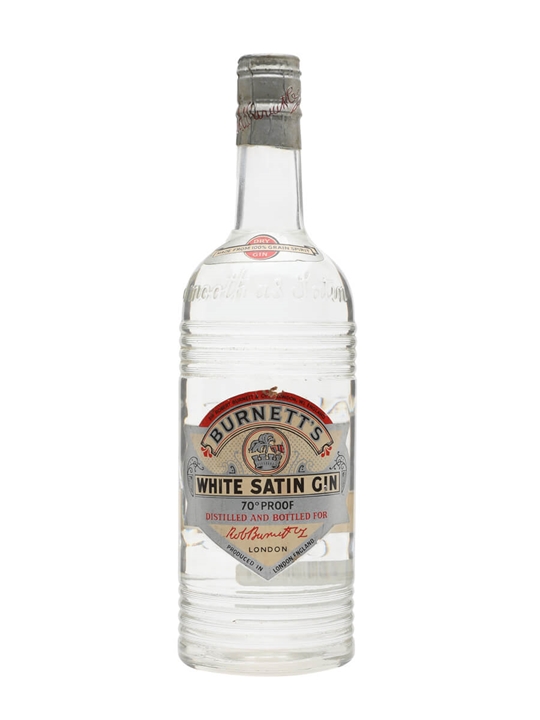

There is something quietly thrilling about handling a bottle that predates most of the modern gin renaissance by half a century. Burnett's White Satin Gin, in its distinctive 1950s bottling with spring cap closure, represents a period when London Dry gin was not a craft movement or a lifestyle accessory — it was simply the default spirit of the English-speaking world. And Burnett's, in that era, was a name that commanded shelf space.
A Window Into Mid-Century London Dry
At 45% ABV, this bottling sits at the robust end of London Dry convention — a strength that was standard before the commercial drift toward lighter, more approachable expressions that characterised the latter decades of the twentieth century. That extra proof would have been a feature, not a flourish, lending the spirit a backbone designed to stand up in a Martini or cut through tonic without losing its identity.
The Burnett's name has a long commercial pedigree, and White Satin was positioned as the brand's flagship — a smooth, accessible London Dry intended for broad appeal. The "White Satin" designation itself is a marketing promise of texture: clean, silky, refined. In a market that had not yet discovered pink gin or butterfly pea flower, this was how you differentiated on shelf.
What makes this particular bottle collectible is the spring cap closure, a mechanical detail that dates the bottling precisely and confirms its mid-century provenance. For enthusiasts of gin history, bottles like this are primary sources — physical evidence of how the category tasted before the botanical arms race began.
I rate this 8.1 out of 10. Not for what it delivers against today's crowded field, but for what it represents: a benchmark of its era, bottled at a proper strength, from a brand that once defined the category.
Best served: If you are fortunate enough to open one, a very dry Martini is the only appropriate context — two-to-one with a quality dry vermouth, stirred, with a lemon twist. This is a spirit that was built for exactly that serve.