
Heritage & Distillery
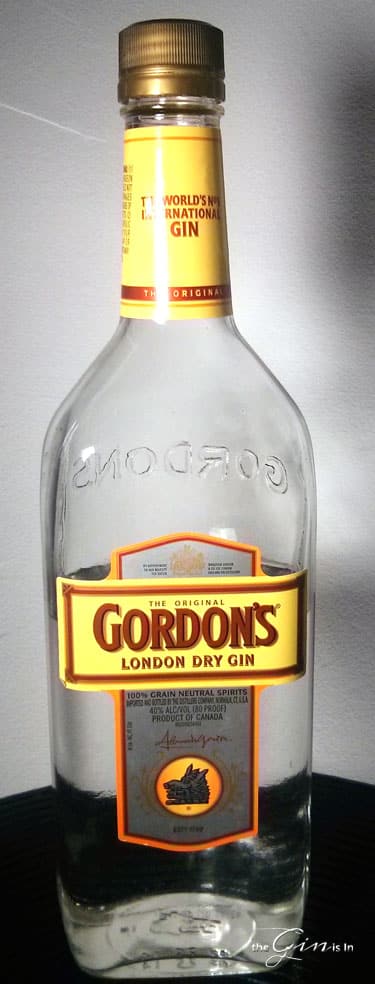
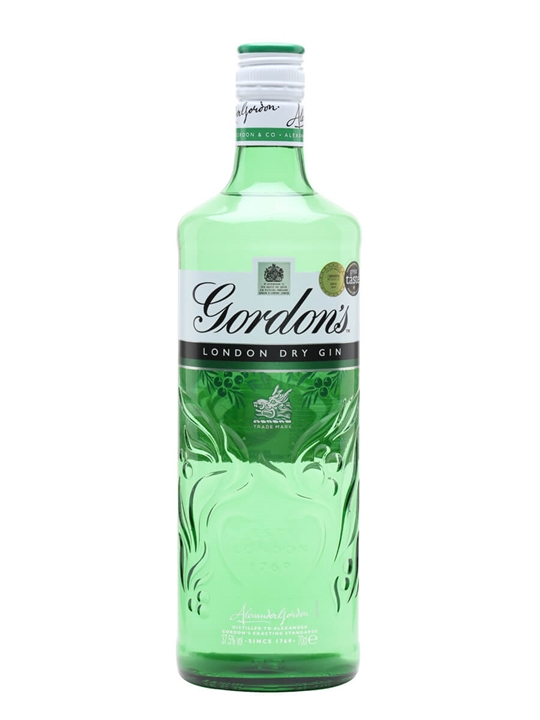
Alexander Gordon founded his distillery in Bermondsey, south London, in 1769, making Gordon's one of the oldest continuously produced gins in the world. The original recipe, developed during an era when gin was transitioning from a rough, sweetened spirit to something altogether more refined, has been a closely guarded secret for over two and a half centuries. The boar's head emblem that adorns the bottle dates from this period, and the brand's association with quality and reliability was established early.
Gordon's history is intertwined with the broader story of British gin. The distillery's growth through the 19th century mirrored the rise of London Dry as a category, and by the early 20th century, Gordon's had established itself as the world's bestselling gin — a position it has never relinquished. The brand passed through various corporate hands before settling with Diageo, where it sits alongside Tanqueray in a portfolio that spans the gin price spectrum.
Yet the story of Gordon's is also one of quiet compromise. In the 1990s, the decision was taken to reduce the ABV of the standard UK and European bottling from 40% to 37.5% — the legal minimum for gin. This was, frankly, a cost-saving measure, and its impact on the liquid was not insignificant. The Gordon's that one encounters today in Britain is a leaner, lighter spirit than the one that built the brand's reputation. It is worth noting that the export bottling, particularly that destined for the United States, remains at 40% and is a noticeably more robust product.
Production
Gordon's is produced using a traditional pot still distillation method. The botanical bill is classical — juniper, coriander, angelica, liquorice, orris root, orange peel, and lemon peel — and the exact proportions have been maintained, according to Diageo, since Alexander Gordon's time. Whether or not one takes that claim entirely at face value, the recipe is certainly well-established and the botanical selection is sound.
The distillation itself is competent and clean. The base spirit is well-rectified, and the botanical flavours are extracted efficiently if not with the artisanal care of smaller producers. The challenge lies not in the production method but in the final ABV. At 37.5%, the spirit simply cannot carry the botanical flavours with the same intensity and complexity as it could at 40% or above. Essential oils that would remain in suspension at higher strengths become less expressive, and the overall impression is one of dilution.
Tasting Notes
On the nose, Gordon's presents recognisable juniper, though it reads as thin rather than bold — a watercolour sketch of the resinous, pine-like juniper one finds in fuller-strength competitors. Lemon and orange peel provide a modest citrus brightness, and there is a faint herbal dryness from the angelica and coriander. The overall impression is clean and inoffensive, but rather muted. One has the sense of a botanical charge heard through a closed door — the shapes are discernible, but the detail has been lost.
The palate confirms the nose's suggestion. The gin is light-bodied and somewhat lean, lacking the viscosity and mouth-coating quality that higher-ABV spirits provide. Juniper is present but fails to develop the resinous depth that defines great London Dry gin. Coriander adds a touch of warmth, the citrus peels contribute a pleasant but fleeting brightness, and liquorice rounds the mid-palate with a gentle sweetness. Nothing is actively unpleasant — the spirit is well-made within its constraints — but nothing particularly excites, either.
The finish is short and clean. The juniper fades quickly, leaving behind a mild citrus dryness and a faint herbal note. It is functional rather than memorable — a gin that does its job without distinction.
The Serve
Gordon's remains a perfectly serviceable mixing gin, and in a well-made G&T with quality tonic, it acquits itself respectably. I would recommend a 1:2 ratio with Schweppes Indian Tonic — there is an honest, workmanlike quality to this pairing that suits the gin's character. A slice of lime rather than lemon, to add a citrus brightness that the gin itself somewhat lacks.
In cocktails, Gordon's can work in drinks where the gin is not required to be the star — a Tom Collins, a Gimlet, a Singapore Sling where numerous other ingredients share the stage. I would not recommend it for a Martini, where the thinness of the 37.5% expression becomes uncomfortably apparent. If you can source the 40% export bottling, it performs meaningfully better across the board.
Verdict
Gordon's London Dry occupies a complicated position. Its heritage is beyond reproach — 250 years of continuous production is a remarkable achievement by any measure. The recipe is sound, the botanicals well-chosen, and the name carries a weight of association that few spirits can match. Yet the decision to reduce the ABV has materially diminished the liquid, and in a market now crowded with well-made alternatives at modest price points, Gordon's no longer stands alone at the value end of the category. At fifteen dollars, it remains inexpensive, and for high-volume mixed drinks where subtlety is not paramount, it serves its purpose. But those seeking a London Dry that truly represents the category's potential should look to spend just a little more. Heritage is a precious thing, but it cannot wholly compensate for what has been taken from the glass.